



 Red wine
 White wine
 Rosé wine
 Primeurs
 Sherry and Port wine
 Sweet wine
 Orange wine
 Vermouth
 Champagne
 Cava
Cava Prosecco
 Lambrusco
 Crémant
 Moscato d'Asti
 Franciacorta
 Pet-Nat
 Corpinnat
 Other sparkling wines
 Wine gift boxes
 Boxed wines
 Boxed sparkling wines
 Wine bottles and glasses
 Gift card
 Non alcoholic Wine
 Non alcoholic Sparkling wine
 Aromas
 Wine conservation
 Decanters and aerators
 Bottle identifiers
 Corkscrews
 Service
 Glass identifiers
 Cleaners
 Accessories set
 Wine glasses
 Contact

Merlot, an elegant and seductive lady
Often in the shadow of Cabernet Sauvignon, the Merlot grape is now considered an essential in the winemaking world thanks to its appearance in a small but exclusive selection of musts that have produced some of the most legendary, expensive and sought-after wines in the world.
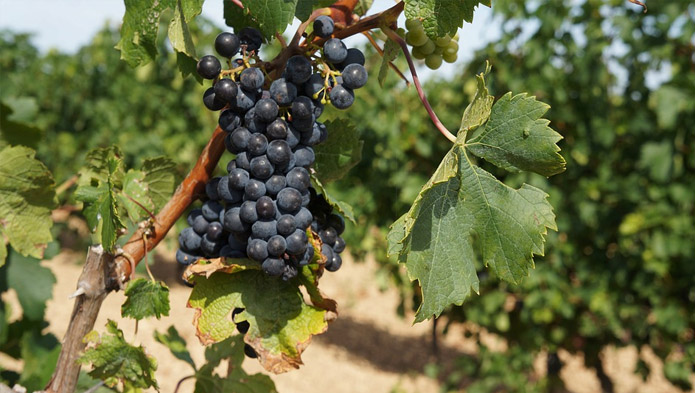
Legend has it that this variety’s name comes from the translation of “merlau”, which means “little blackbird” a bird with a certain penchant for the ripe and sweet Merlot berries and with a similar blue-black colour.
Merlot is the result of a cross between Cabernet Franc and Magdeleine Noire des Charentes strains, so you could say it is a “sister” of Cabernet Sauvignon, a variety that it is often found with in coupages and that it is so similar to, so much so that in blind tastings they are often confused.
There are over 60 names you might know this variety by, for example: Alicante Noir, Bigney, Black Alicante, Blauer Merlot, Bordò, Crabutet, Crabutet Noir, Hebigney, Médoc Noir, Merlau, Merlot Black, Merlot Blau, Merlot Crni, Merlot Nero, Merlot Noir, Merlott, Merlou, Picard, Pikard, Plant Médoc, Sémillon Rouge, Vidal, Vitraille, etc.
What is the Merlot grape like?
It originates from Bordeaux, France, where it is the most planted strain. In Saint-Émilion and Pomerol it is the star of their great wines and in Médoc it plays an important part in the famous Bordeaux coupage.
It usually grows in the same climates as the Cabernet Sauvignon, Cabernet Franc, Malbec and Petit Verdot varieties.
It is one of the three most planted grapes in the world and it grows in many countries, for example Spain, Italy, Portugal, United States, Argentina, Australia, New Zealand and Chile, even in places that seem unlikely, Algeria and Cyprus.
This vine produces small oval berries, with thick blue-black skins that are hard to remove, and with large leaves made up of five well-defined lobes that create a pentagonal shape.
The Merlot variety ripens early, but it is easy to grow because it adapts to different kinds of soils. This grape likes cool weather, which is where it expresses itself and develops best. In hot temperatures, it usually loses its acidity and tannic balance.
This strain is also fairly resistant to diseases but is sensitive to frost and botrytis in ripeness and over-ripeness.
What kind of wine does it produce?
Merlot wines captivate with their expressive aromas and flavours of blackcurrants and black cherries, their soft and flexible tannins and a finish of chocolate.
In hot climates the variety produces red wines that are usually more fruity, with refined tannins and aromas of cherries, raspberries and violets. They are dry but voluptuous and fruity wines, with spicy notes and a delicious touch of chocolate and mocha.
In cold climates, which this grape prefers, the results are more structured wines with a delicate earthy note, hints of red and black fruits and slightly more acidic. The nose has a greater complexity revealing floral aromas of violets, balsamic notes and nuances of truffles and undergrowth. They are usually less concentrated and offer pleasant hints of chocolate or liquorice.
This grape is often used in coupages with the Cabernet Sauvignon and Cabernet Franc varieties (the famous Bordeaux-style coupage) because it softens and balances the tannins and provides a fruity touch to the resulting wines.
It is often said that the Merlot variety contributes the feminine aspect of coupages that contain Cabernet Sauvignon, that is, it softens the powerful tannin of the Cabernet and provides subtlety and elegance with its fruity character and velvet touch.
It is an elegant and sensual grape. And as well as their feminine and masculine roles, they are also like Ying and Yang, two opposing forces, interdependent and complementary and that can be transformed into the other, which means they can be mistaken for each other. Finding wines with the perfect balance of these two great varieties in the same coupage is an exquisite pleasure.
Some facts about the Merlot variety
During the 19th century, grafts from Bordeaux were taken to Chile and were thought to be Merlot strains, however, studies conducted in 1994 by a researcher named Jean Michel Boursiquot found that it was a completely different variety, which today we know as Carménère. This has become the flagship grape of wines made in this South American country. The Carménère vines have leaves that are practically identical to Merlot leaves.
In the 90s, wines made with Merlot in California had a bad reputation because of their softness, inconsistency and sweet edge. Then, “thanks” to the famous movie “Sideways”, translated as “Entre Copas”, one of the characters’ open disdain towards the Merlot grape saw sales fall and its reputation deteriorate further, while wines made with the Pinot Noir variety, the protagonist’s favourite, became more popular.
Although loved by some and underestimated by others, it is undeniable that the discreet role of the Merlot variety, which often remains in the background, has produced some of the most sought-after and expensive wines in the world. For some of these wines, it has finally become the absolute star, as is the case with the famous Pétrus, which we have talked about so much, a great red wine from Bordeaux made in Pomerol.
Initially it was a Merlot coupage with a small percentage of Cabernet Sauvignon. It is now a single-variety Merlot that is made in extraordinary vintages and can reach exorbitant prices on the market.
Despite the reputation of this strain as a grape that produces young and simple wines, so many people are still unaware of the great potential and elegance of a wine made with Merlot. They are able to continue aging and improving in the bottle for years to come.
Why not take a look at our selection of Merlot wine and discover all the wonderful secrets and the seductive nature of this elegant wine.


