


 Red wine
 White wine
 Rosé wine
 Primeurs
 Sherry and Port wine
 Sweet wine
 Orange wine
 Vermouth
 Champagne
 Cava
Cava Prosecco
 Lambrusco
 Crémant
 Moscato d'Asti
 Franciacorta
 Pet-Nat
 Corpinnat
 Other sparkling wines
 Rhum
Rhum Gin
Gin Whisky
 Vodka
Vodka Cognac
 Brandy
 Pastis
 Tequila
 Mezcal
 Grappa and Eau de vie
 Calvados
 Liqueurs
 Pacharán
 Apéritifs
 Wine gift boxes
 Boxed wines
 Boxed sparkling wines
 Wine bottles and glasses
 Gift card
 Non alcoholic Wine
 Non alcoholic Sparkling wine
 Non alcoholic Gin
 Other non-alcoholic drinks
 Aromas
 Wine conservation
 Decanters and aerators
 Bottle identifiers
 Corkscrews
 Service
 Glass identifiers
 Cleaners
 Accessories set
 Wine glasses
 Contact

Discovering Bertrand Sourdais of Dominio de ES
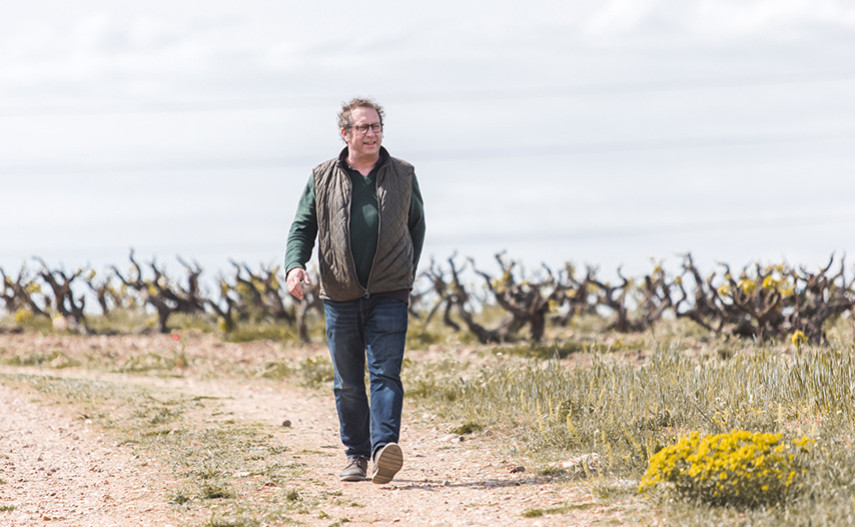
Interviewing Bertrand Sourdais is no easy task. He arrives with the energy of someone constantly immersed in multiple projects, and there's hardly a need to pose the first question before the conversation takes off. One idea leads to another, an anecdote unfolds into a reflection, and almost without realising it, he has answered everything you wanted to know and much more.
A torrent of knowledge, memories, and convictions paints the portrait of a man unable to separate wine from life. All of this is seasoned with expressions that surprise, coming from a Frenchman born in the Loire. He speaks of being a "restless soul", of "getting into scrapes", or of always having "troubles on his hands" with the ease of someone who has spent half his life in Spain. It's hard not to be swept up by his enthusiasm.
It has been 25 years since this Frenchman arrived in the Soria region of Ribera del Duero. He came alongside Álvaro Palacios, whom he admires for his ability, as he himself says, to break through barriers to show the world what Spanish wine truly is.
The Lesson of Soria
"I arrived thinking I was the king... and discovered I had no idea." Bertrand Sourdais does not shy away from self-criticism. He arrived in the Soria region of Ribera del Duero at just 23 years old, with a solid oenological education and experience in some of the finest wineries. He believed he had the necessary tools to craft great wines, but the first harvest in 2000 reminded him that the vineyard always has the final say. Although he knew a great deal... the wine wouldn't ferment. That experience was a lesson in humility. "Agriculture always brings you back down to earth," he summarises.
However, that learning experience did not mean abandoning the sensitivity he brought from the Loire. On the contrary, his perspective was one of his greatest contributions. He arrived in a Ribera del Duero dominated by powerful and structured wines, while he advocated for a lighter, fresher, and more elegant interpretation, inspired by the tradition of his homeland. But first, he had to learn to listen to the place before him. "Everything I was taught at university had little to do with the legacy I found here."
Over time, he understood that this legacy was the true treasure of Soria. A heritage of old vines, landscapes, and knowledge accumulated over generations. His work involved uniting both perspectives, allowing the climate, altitude, and those ancient vines to express themselves with greater precision, without ever losing the identity of the territory.
The Treasure Few Could See
Sourdais speaks of Soria with a blend of admiration and gratitude. He calls it "my Soria". And perhaps precisely because it was a forgotten land for decades, it preserved something that today is extraordinary. While in other places old vines were uprooted to plant more productive varieties, here there was hardly any transformation. The neglect eventually became an advantage; the viticultural heritage remained intact. As he himself says: "having one foot in the past gives a different flavour in a world that moves too fast".
And indeed, if there is something that obsesses Bertrand more than the soil, it is the climate. For him, that is one of the keys to Soria. Situated between the Iberian System and the Central System, the area boasts two great natural barriers that function as a unique thermal regulation system. "We have free air conditioning. Sometimes it comes at a cost…, but it's free."
The frosts, the thermal differences, the altitude, or the wind are part of the price to pay for crafting wine in this territory. But precisely those extreme conditions are what allow for a unique expression. He recalls a lesson from his father and grandfather: "The best expression of a variety appears when it is at the northern limit of its cultivation". And for him, Soria represents exactly that; a climatic frontier where the vine must strive and, precisely because of this, can offer its most authentic personality.
Each Vintage Has a Name and Surname
Listening to Bertrand Sourdais talk about the harvests is to understand the extent to which he lives attuned to the vineyard. He recalls with almost obsessive precision how each spring was, when a frost arrived, what happened during the summer, or how a specific plot responded after an unexpected storm. He speaks of each vintage as one would speak of a child, because he knows that none resemble the previous one. Each year the climate writes a different story on the vineyard and that story is captured in the wine.
That is why he speaks of the wines of each year with the same familiarity with which others recall moments from their own lives. He does not seek for all the harvests to be the same, but for each to preserve the memory of what occurred in the vineyard. For Bertrand, the greatness of wine lies in its ability to encapsulate a landscape, a climate, and an unrepeatable moment within a bottle. And that is the imprint we find in each of his wines. Perhaps that is why, when the conversation ends, it feels as though one has not only discovered a great winemaker but a man who came to make wine and ended up finding a place to call home.