 Red wine
 White wine
 Rosé wine
 Primeurs
 Sherry and Port wine
 Sweet wine
 Orange wine
 Vermouth
 Champagne
 Cava
Cava Prosecco
 Lambrusco
 Crémant
 Moscato d'Asti
 Franciacorta
 Pet-Nat
 Corpinnat
 Other sparkling wines
 Rhum
Rhum Gin
Gin Whisky
 Vodka
Vodka Cognac
 Brandy
 Pastis
 Tequila
 Mezcal
 Grappa and Eau de vie
 Calvados
 Liqueurs
 Pacharán
 Apéritifs
 Wine gift boxes
 Boxed wines
 Boxed sparkling wines
 Wine bottles and glasses
 Gift card
 Non alcoholic Wine
 Non alcoholic Sparkling wine
 Non alcoholic Gin
 Other non-alcoholic drinks
 Aromas
 Wine conservation
 Decanters and aerators
 Bottle identifiers
 Corkscrews
 Service
 Glass identifiers
 Cleaners
 Accessories set
 Wine glasses
 Contact

Interviewing Gorka Mauleon of Mozo Wines
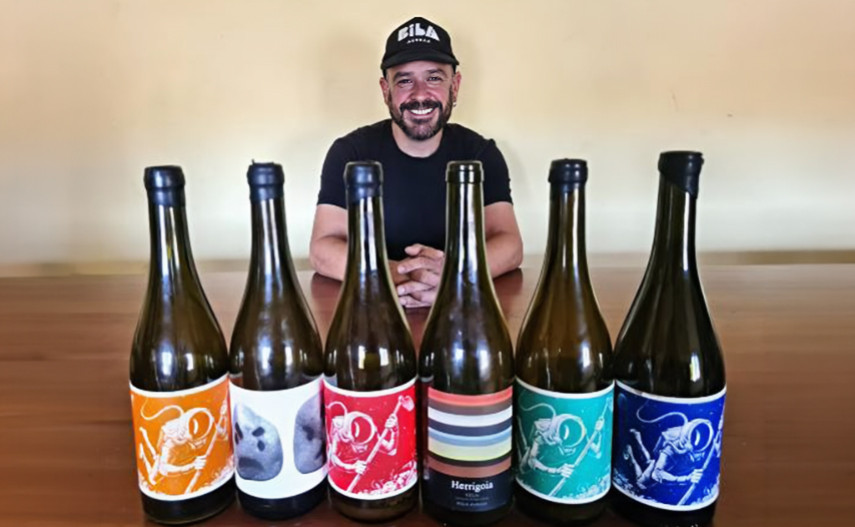
Meeting Gorka is to encounter an infectious energy. He speaks about wine, vineyards, and La Rioja with such clarity and passion that it's hard to believe he worked as a computer scientist for years.
Observing him elucidate every corner of his homeland, it becomes inevitable to think that such a talent for communication was underutilised in front of a screen. For Gorka does not merely speak of wine; he narrates stories, conveys emotions, and manages to make one fall in love with that small, authentic, and deeply cherished Rioja that is so often overshadowed by the big names.
However, to comprehend Gorka, one must also understand Lanciego, a village where the wine culture is deeply ingrained and where the vineyards are part of the collective memory. Here, wine has never been merely an economic activity, but a way of connecting, gathering, and sharing life. Gorka, who was also the mayor of the locality, is well-acquainted with this bond between land, neighbours, and tradition.
Today, alongside his partner Itxaso and Unai, her brother and the third generation of the family, he is one of the custodians of a unique heritage. A legacy built on old vineyards, rural memory, and a way of understanding wine that looks to the past to build the future.
A story of returning to move forward
The project was initiated in the 1970s by Cesáreo, affectionately known as "El Mozo". In 1980, he began producing and selling bulk wine through carbonic maceration, the traditional style of the area.
Decades later, the story took a turn. Itxaso, Cesáreo's granddaughter, and Gorka had built their lives away from the village, between Barcelona and Sant Cugat del Vallès. But in 2010, Itxaso's father, Félix, passed away, prompting a question that would change everything: should they return or let the project end? The answer was clear. They had to return.
Returning was not just about reclaiming a family winery; it was about going back to a land where wine had always been part of the inhabitants' identity. In Lanciego, vineyards have shaped the social life of the village for generations. In the past, there were even exchanges between the youth of Lanciego and Mendoza (Argentina), a tradition that reflects how wine also served as a link between communities on different continents.
The change was radical. From the office to the tractors. From meetings to the vineyard. From computers to the vines. Although both had grown up among vineyards, discovering what it truly means to make wine was quite an odyssey. And if making wine is already complicated, selling it is even more so. Technical knowledge alone is not enough. Empathy, storytelling ability, and a great deal of perseverance are required. Gorka demonstrates this every time he speaks. Listening to him is to understand that behind a bottle, there is always much more than just wine.
The treasure of old vineyards
Long before the words "ecology" and "sustainability" became fashionable, they were already working in this way. Not as a strategy, but out of conviction. They simply continued the way of cultivating the land they had learned from their grandparents and great-grandparents. In Lanciego, no one saw it as extraordinary, but as the natural way of doing things.
This relationship with the land also explains the importance they place on their old vineyards: vines 60, 70, and even 80 years old that preserve the diversity of bygone eras, when different varieties coexisted in the same plot. From this richness, their micro-wines are born, or as Gorka puts it, "bottled plots". These are wines that faithfully express the character of each vineyard.
The challenges of the present
But the past alone is not enough to address the challenges of the future. Climate change is already transforming the reality of the vineyard. Harvests are occurring earlier, agricultural cycles are changing, and even many traditional celebrations are losing the temporal reference that for generations marked the work in the fields.
To this is added the market situation. Less wine is consumed than a few decades ago, and Rioja is burdened with overproduction issues. For years, a logic based on "good, beautiful, and cheap" prevailed, but when price becomes the only variable, someone ends up paying the price. And it is almost always the farmer.
This is why Gorka emphasises the need to show what lies behind a bottle. Families, villages, entire generations, and small producers striving to keep a territory alive. After all, as he himself says, depopulation begins at the supermarket.
Perhaps one of the great pending challenges for Rioja is to better tell its own story. A region much more diverse than what has been explained to us for years. There are landscapes, styles, varieties, and methods of production that rarely appear in the official narrative. And communicating this remains an unresolved issue for many wineries that, paradoxically, have fascinating stories to tell.
As we discuss all this, in the glass we have Herrigoia, a wine that encapsulates the philosophy of the house. A fresh and direct carbonic maceration wine that accompanies the conversation naturally, just like the cave of Mozo Wines, an old traditional cellar turned wine bar where they share wines, gatherings, and moments with the townspeople, reviving the social character that wine has always had in Lanciego.
Because in the end, as with Gorka's way of understanding wine, a bottle is not just about its contents, but everything that happens around it.