


 Red wine
 White wine
 Rosé wine
 Primeurs
 Sherry and Port wine
 Sweet wine
 Orange wine
 Vermouth
 Champagne
 Cava
Cava Prosecco
 Lambrusco
 Crémant
 Moscato d'Asti
 Franciacorta
 Pet-Nat
 Corpinnat
 Other sparkling wines
 Rhum
Rhum Gin
Gin Whisky
 Vodka
Vodka Cognac
 Brandy
 Pastis
 Tequila
 Mezcal
 Grappa and Eau de vie
 Calvados
 Liqueurs
 Pacharán
 Apéritifs
 Wine gift boxes
 Boxed wines
 Boxed sparkling wines
 Wine bottles and glasses
 Gift card
 Non alcoholic Wine
 Non alcoholic Sparkling wine
 Non alcoholic Gin
 Other non-alcoholic drinks
 Aromas
 Wine conservation
 Decanters and aerators
 Bottle identifiers
 Corkscrews
 Service
 Glass identifiers
 Cleaners
 Accessories set
 Wine glasses
 Contact

Vineyards that extinguish fires
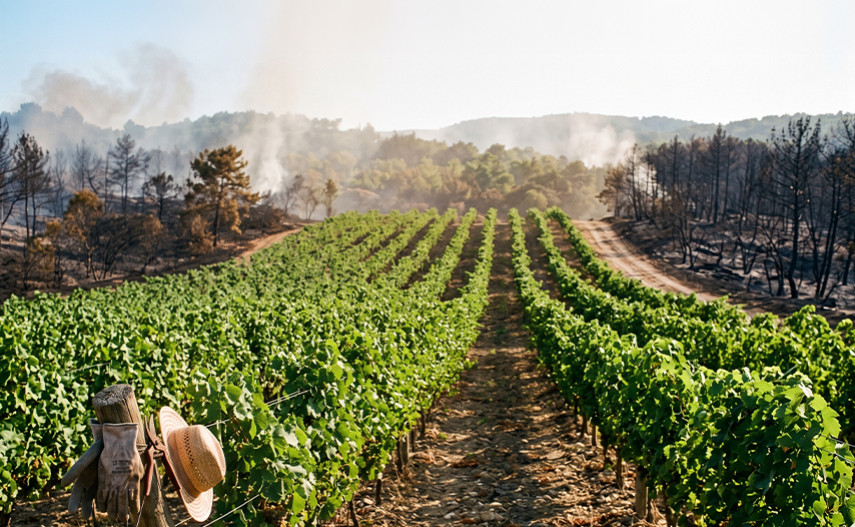
Regrettably, each summer witnesses the same scene: mountains shrouded in smoke, forests reduced to ashes, and residents anxiously monitoring the progress of the flames. Rising temperatures, drought, and the neglect of many rural areas have turned forest fires into one of Europe's most significant environmental challenges.
Nevertheless, amidst this bleak outlook, the vineyard is proving that it can play a far more significant role than merely producing exceptional wines.
Vineyards have become genuine natural firebreaks. Being consistently cultivated and maintained lands, they exhibit a reduced accumulation of dry vegetation, which hinders the fire's progression. In numerous fires, these plots have halted the spread of flames, safeguarding forests, agricultural operations, and even inhabited areas.
However, this silent endeavour comes at a cost. When the fire reaches the vineyards, farmers are often the first to suffer. Frequently, their crops act as a barrier against the blaze but end up damaged or destroyed, forcing the winegrowers to face significant economic losses while inadvertently contributing to the protection of the land.
A seal to recognise those who care for the landscape
With the aim of acknowledging the role some crops play in preventing forest fires, in July 2025, the European Union Intellectual Property Office registered the certification marks Fire Wine Resilient Landscape© and Fire Product Resilient Landscape©. These labels identify wineries and agricultural producers whose operations, in addition to producing food or wine, help create landscapes more resilient to fire.
The seal highlights a way of managing the land where agricultural activity helps reduce the continuity of combustible vegetation and fosters a mosaic landscape capable of hindering the spread of large fires.
These certifications are owned by the Forest Science and Technology Centre of Catalonia (CTFC) and have been developed as a tool to convey to the market the environmental value provided by certain crops. Their development is supported by knowledge generated from various European research projects, including LIFE MIDMACC, which between 2019 and 2024 demonstrated how the recovery of vineyards and other agricultural uses in mid-mountain areas can act as a natural firebreak and, at the same time, contribute to revitalising the rural environment.
The mosaic that hinders the fire's advance
One of the finest examples of this model is found at the Mas Marés estate of Espelt Viticultors, located in the vicinity of the Cap de Creus Natural Park. There, the vineyard planting was not solely intended for viticultural purposes but also as part of a comprehensive landscape management project.
Since the planting began in 2003, the estate's design was carried out in collaboration with the natural park's managers to create an agroforestry mosaic capable of promoting biodiversity while simultaneously reducing the risk of fires.
The land is organised into three distinct areas. The holm oak groves preserve one of the region's richest ecosystems in terms of biodiversity. The pastures remain open thanks to livestock grazing, which naturally removes combustible vegetation. Surrounding the vineyards are stretches of scrubland, which not only act as a protective strip but also provide an ideal habitat for species such as the lesser kestrel, currently the focus of recovery programmes.
Much more than producing wine
Viticulture is demonstrating that it can offer benefits far beyond wine production. Keeping the crops active means preserving the landscape, generating biodiversity, stabilising rural populations, and reducing the risk of large-scale fires.
In a context where fires are increasingly intense and difficult to control, supporting those who work the land can become one of the most effective tools for protecting the territory. Because, at times, the best defence against a fire does not begin when a water bomber takes off, but much earlier, among the rows of a meticulously cultivated vineyard.