


 Red wine
 White wine
 Rosé wine
 Primeurs
 Sherry and Port wine
 Sweet wine
 Orange wine
 Vermouth
 Champagne
 Cava
Cava Prosecco
 Lambrusco
 Crémant
 Moscato d'Asti
 Franciacorta
 Pet-Nat
 Corpinnat
 Other sparkling wines
 Rhum
Rhum Gin
Gin Whisky
 Vodka
Vodka Cognac
 Brandy
 Pastis
 Tequila
 Mezcal
 Grappa and Eau de vie
 Calvados
 Liqueurs
 Pacharán
 Apéritifs
 Wine gift boxes
 Boxed wines
 Boxed sparkling wines
 Wine bottles and glasses
 Gift card
 Non alcoholic Wine
 Non alcoholic Sparkling wine
 Non alcoholic Gin
 Other non-alcoholic drinks
 Aromas
 Wine conservation
 Decanters and aerators
 Bottle identifiers
 Corkscrews
 Service
 Glass identifiers
 Cleaners
 Accessories set
 Wine glasses
 Contact

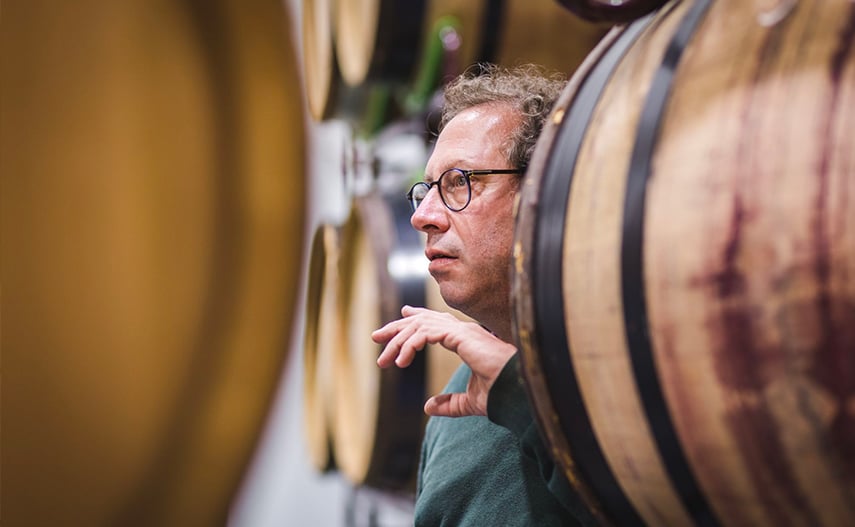
Meeting Bertrand Sourdais, the Vigneron of Soria
A true friend to his friends, Bertrand Sourdais is a thoroughbred French winemaker who has firmly established himself in Spain. With over 24 years of experience in the lesser-known area of Ribera del Duero since his arrival in 1999, he quickly recognised the immense potential of the region. Primarily, he discovered a genuine gem in the untouched old vines of Soria. In 2011, he founded Dominio de Es with the French concept of Domaine and a second winery, Antídoto, to demonstrate that a more fluid, joyful, and fun Ribera Soriana also exists. But as if that weren't enough, he is also responsible for the wines from his family winery Domaine de Pallus in the Loire (France) and those from Galia, a Sorian winery he recently acquired from his friend, the vigneron Jerôme Bougnaud. In short, a total of four properties managed by the same hands, each with its own unique personality. It is a true pleasure to share a glass of wine with him.
1- With no less than four generations of winemakers behind you, you navigate the vineyard like a fish in water. What is your earliest memory of wine from your childhood on your parents' farm in the Loire?
When I was little, in the winery, my father would have me fill the bottles, but when I overfilled them, I would take a sip to level it out. I remember one day my father caught me with wine-stained lips.
2- Growing up in such a rural environment, it seems your path was set from a young age. But what truly hooked you and made you realise you wanted to dedicate yourself to winemaking?
In Bordeaux, I discovered the magic of the vineyards. Until then, I moved around the Loire as if it were home. But once I left there, without references, alone, in Bordeaux, a world opened up to me that I fell in love with, and I realised this is what I truly wanted to do.
3- In your oenological training, you have worked at legendary wineries such as Clos Rougeard in the Loire, Mouton Rothschild, Château Léoville Las Cases, Alvaro Palacios, and Château Nénin in Bordeaux. What led you to cross the Pyrenees?
In Bordeaux, I met Ricardo Pérez Palacios, "Titín" to his friends, and he invited me to the village festivals in Alfaro (La Rioja). It was 1996. Until then, I was unfamiliar with the vineyards of the peninsula.
4- In 1999, you settled in Soria, a province that did not enjoy the same prestige as neighbouring Valladolid and Burgos. Why did you bet on the less valued area of Ribera del Duero?
When I arrived in Soria, I was unaware of which areas had more or less prestige. I knew nothing about the region. So, I couldn't have any preconceived ideas about the place. At that moment, I was captivated by the altitude, the cold, and the old ungrafted vines. Values that I still hold dear.
5- In Soria, you started Dominio de Atauta, a project that surprised by going against the grain of what had been done until then in Ribera del Duero. What did you disrupt? What do you take away from that stage?
On a personal level, it was a learning stage where I discovered and learned about the soil, the climate, and the vineyard. A learning experience of the area. On a global level, it was a project whose mechanism flowed very quickly. If you go against the grain, it's easy to get noticed. First, for producing fresher and more balanced wines than those made in this area until then, and second, for having a very good distribution network. Two components that made us rise like foam.
6- You have said that to make a good wine, you need "idea and gesture," that is, a clear concept and savoir-faire. Do you think it is difficult to maintain your ideals in the wine world to achieve your goal?
It is very difficult because we are constantly bombarded with new trends, fashions, and influences. The worst thing is to have preconceived ideas that can make you hesitate and take the wrong path. But also, in our profession, we only have one opportunity a year to make a wine. We cannot fail, and it is hard to take risks.
7- After working for ten years at Atauta, you took the plunge with your new project, Dominio de Es. At a time when you can speak your mind, do you think the winemaking influence of your family winery in Chinon is reflected in wines like La Mata, La Diva or Viñas Viejas de Soria?
Yes, it reflects the influence because we follow the same structure as in France. Wines made by parcels and blending with the best crus of the village.
8- The vineyards you cultivate are worked based on parceling, a Burgundian concept that often clashes with numbers and profitability. Do you think the future of Ribera del Duero lies in the diversification of soils?
I don't think it's the solution. More and more people want to know more about wine, and when they get to Burgundy, they get confused. No one can know all the parcels that exist. Imagine trying to do the same in the 30,000 hectares of Ribera del Duero. In my opinion, a first step would be to organise the areas by provinces (as is done in Rioja). This way, the public can understand and know where they are on the map. I think it would be a very good option to refine the structure. A gentle classification that is well assimilated and not intimidating. Likewise, I believe that in a wine, the human factor accounts for 50% or more. The same terroir does not have the same result with one vigneron or another. How do you reflect this in a classification?
9- Your second project, also in Ribera del Duero, is Antídoto. Is the name "Antídoto" meant to counteract what you don't like about the wine world?
When I left Dominio de Atauta, I was not in my best moment, and starting my own project served as a remedy for my discomfort. A true antidote!
10- With your entry-level wine, Antídoto, you present a new, more fun Ribera del Duero. With La Hormiga, an authentic single-vineyard wine, and with Le Rosé and Roselito, you give voice to the rosés of the area. In one word, could you define what each of them brings to you?
I would define all four wines with the word "Update." In reality, we have reset the incredible historical heritage in Soria. Old vines that we have interpreted with modern times.
11- At Domaine de Pallus, the family winery you have in Chinon, your work reveals, above all, the charm and historical character of cabernet franc. What does Ribera have in common with the Loire that makes you feel at home?
If there is something in common between the Loire and Ribera del Duero, it is that both reflect the influence and importance of the river in the development of viticulture and wine production.
12- And there is no three without four. Now you have embarked on a new initiative, taking over the management of Galia, a winery in Castilla y León that stands out for its old vineyards along the Duero. What would you highlight about the style of the wines from this winery?
Touring old vineyards in Soria, if there is something to highlight about the style of the wines from this project, it is their anarchist air. That is, not being within the denomination and with less interventionist work, they are freer wines. On one hand, Las Aldeas de Galia is a village wine where we have made a free interpretation. On the other hand, Galia Clos Santuy, its older brother, being a Cru, shows precise characteristics that give it its own identity. Both wines, however, are 100% from Sorian vineyards.
13- Our parents were loyal to a brand; today, no one is married to any. What is the public looking for today? Do you think the new generations find it difficult to know and enjoy wine culture?
If it is true that each individual is unique, if we generalise, the new generations are in search of discovery. Each bottle is a journey, and the glass transports you to the place of origin. Later, when you are more mature, you seek quality. You know more about wine and can recognise when a wine is good, you settle more and travel less.
14- As a good vigneron, you surely have a passion for good wine, good food, and good company. But in day-to-day life, between stoicism (self-discipline) and epicureanism (hedonism), which of the two philosophies is better for facing the modern wine world?
If there is something good about our profession, it is that there are no limits. Everyone does what they want. Having freedom is a blessing, and you don't have to marry any style. If you like to innovate, you can experiment. If, on the other hand, you like to be a traditionalist, you can follow the old ways. To each their own...
15- Finally, could you suggest a wine that has recently captivated you?
There are many... The truth is, I have been pleasantly surprised by Les Pensées de Pallus 2019. I feel proud and believe this vintage is very accomplished. A wine that has also captivated me is Giuseppe Mascarello Monprivato Gran Reserva 2015, a very open Barolo where, for the first time, I have seen this great terroir so clearly, a Rayas 2012, and a Trotanoy 2012, tasted recently, wow! How delicious!