



 Red wine
 White wine
 Rosé wine
 Primeurs
 Sherry and Port wine
 Sweet wine
 Orange wine
 Vermouth
 Champagne
 Cava
Cava Prosecco
 Lambrusco
 Crémant
 Moscato d'Asti
 Franciacorta
 Pet-Nat
 Corpinnat
 Other sparkling wines
 Rhum
Rhum Gin
Gin Whisky
 Vodka
Vodka Cognac
 Brandy
 Pastis
 Tequila
 Mezcal
 Grappa and Eau de vie
 Calvados
 Liqueurs
 Pacharán
 Apéritifs
 Wine gift boxes
 Boxed wines
 Boxed sparkling wines
 Wine bottles and glasses
 Gift card
 Non alcoholic Wine
 Non alcoholic Sparkling wine
 Non alcoholic Gin
 Other non-alcoholic drinks
 Aromas
 Wine conservation
 Decanters and aerators
 Bottle identifiers
 Corkscrews
 Service
 Glass identifiers
 Cleaners
 Accessories set
 Wine glasses
 Contact

How is Brandy de Jerez produced?
Have you ever wondered about the creation of the exquisite drink known as Brandy de Jerez? Join us on a journey to uncover the secrets behind its production, which involves a meticulous blend of tradition, quality, and an unparalleled flavor profile.
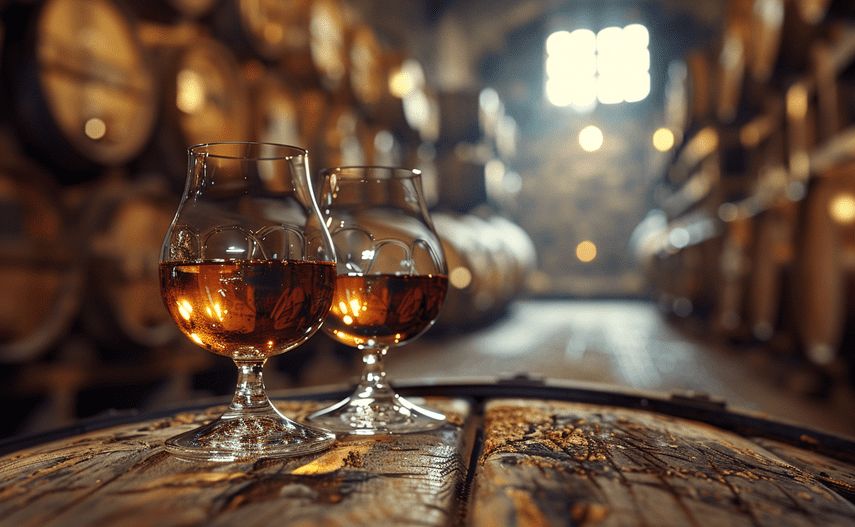
It is commonly stated that a brandy is a distilled spirit made from grapes or other fruits (such as apples, pears, cherries...) that assumes a distinctive name based on the final product and place of production (cognac, grappa, pisco, armagnac...), where each ingredient contributes its unique character and personality to the spirit.
Today, we will discuss one of the distinguished names in brandy that, with its quality and character, has captivated taste buds worldwide: Brandy de Jerez.
The production process of Brandy de Jerez begins with the selection of white grape varietals, airén and palomino, which are traditional in the Jerez region. Approximately three liters of wine are required to produce one liter of brandy.
It is crucial to highlight that only healthy, clean, and well-balanced wines are used, which will undergo a distillation process, either in a column still or in copper pot stills known as alembics, to obtain the eau-de-vie that will be transformed into Brandy de Jerez.
Each distillation is divided into three parts, according to their purity: the heads, the hearts, and the tails, with the central part (the heart) being of the highest quality.
The heart of the distillation is the portion that is selected for aging to become brandy, while the remainder (heads and tails) is discarded. Hence, each bottle of Brandy de Jerez is said to contain "the spirit of the wine."
What sets Brandy de Jerez apart from other brandies are its unique organoleptic characteristics, which are the result of the traditional production system, the nature of the wooden casks in which it matures, and, of course, the specific climatic conditions of the Marco de Jerez region.
An integral part of the aging process of Brandy de Jerez takes place in American oak casks or 'botas', which have been previously seasoned with some of the traditional fortified wines of Jerez (oloroso, amontillado, Pedro Ximénez...).
These 500-liter casks impart their characteristic flavor and aroma to the brandy during the aging process, which is conducted under the 'criaderas y soleras' system, involving the gradual transfer of the spirits through different levels of aging; a fundamental process key to adding complexity, smoothness, and a unique personality to the final brandy.
Depending on the aging time, there are three classes of Brandy de Jerez: the young and fruity Brandy de Jerez Solera, with a minimum aging of six months; the fragrant and velvety Brandy de Jerez Solera Reserva, aged for at least one year; and the refined and complex Brandy de Jerez Solera Gran Reserva, which undergoes the longest maturation, with a minimum average of three years as required by regulations, although it is common to find brandies that far exceed this minimum aging period.
In summary, Brandy de Jerez is a masterpiece that blends art, harmony, and the tradition of the region, resulting in a unique and inimitable beverage that delights the senses and celebrates Jerez's rich winemaking heritage.