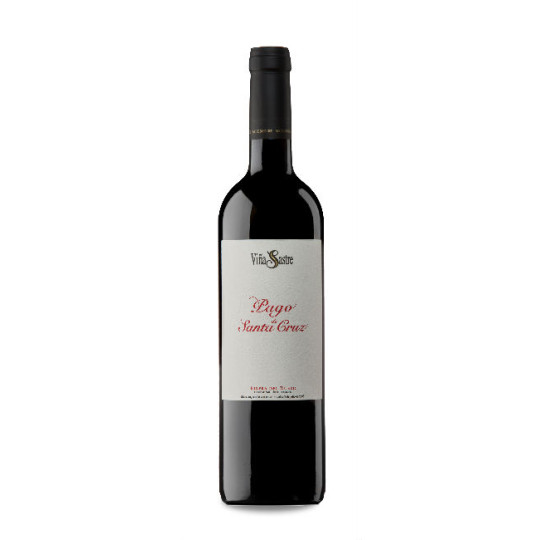


All exceptional wines find their origins in the vineyard, and Pago de Santa Cruz Gran Reserva is no exception. This exquisite red wine is crafted by Hermanos Sastre winery, located within the esteemed D.O. Ribera del Duero region.
Presently, the D.O. Ribera del Duero encompasses over 100 municipalities, with the Duero River as its central axis. Yet, to discover the pinnacle of Hermanos Sastre's craftsmanship, one must venture to La Horra, in Burgos. It was here that, in 1992, the family elected to establish their winemaking enterprise. Thirty years ago, they possessed 23 hectares of land, from which they aspired to extract only the finest quality, honoring the earth while preserving the most traditional cultivation and vinification methods. Nestled in Castilla y León, in the north-central part of the Iberian Peninsula, the vineyards sink their roots into the riverbanks, perched at altitudes ranging from 750 to 900 meters. Pago de Santa Cruz Gran Reserva is situated near the upper limit, at 840 meters above sea level, on the slopes of the Duero and Gromejón rivers. Here, the soil is clayey-calcareous, with a loose texture, low fertility, and ideally suited for viticulture. These same soils, which act like sponges retaining moisture, enable the vines to withstand the long, arid summers characteristic of the continental Mediterranean climate (accompanied by equally cold and prolonged winters). However, this appellation is particularly noted for the vast range of temperature fluctuations between day and night. Such significant variation aids in the deposition of anthocyanins, polyphenolic compounds essential in red grapes, responsible for imparting color to the fruit.
Pago de Santa Cruz Gran Reserva is a single-varietal wine made from Tempranillo grapes, also known as Tinta del País or Tintorera, which flourish in venerable vineyards. From these vines, some exceeding 80 years of age, one can anticipate a yield that prioritizes quality over quantity. And indeed, it does. Consequently, vineyard management is crucial; only natural farming practices are embraced, eschewing herbicides and insecticides in favor of manual labor. The most noteworthy of these tasks, the harvest, is meticulously carried out by hand in 12 kg crates. During this critical process, careful attention is also devoted to the selection of grape clusters, ensuring that only the finest specimens reach the winery. Once there, the harvest undergoes a further scrutiny on a sorting table. With exemplary fieldwork complete and graded outstanding, the remainder of Pago de Santa Cruz Gran Reserva's production takes place in stainless steel vats, where it ferments using indigenous yeasts at a controlled temperature. Following fermentation, Pago de Santa Cruz Gran Reserva is naturally stabilized, leveraging the cold temperatures of La Horra during December and January. By exposing the vats outdoors, where temperatures can plummet to -15 °C, the wine is clarified without the need for machinery or chemicals.
Once clarified, Pago de Santa Cruz Gran Reserva is transferred to the aging cellars, where it will continue to develop its character in the barrel room, until the moment arrives to showcase the dedication and effort invested in the vineyard.