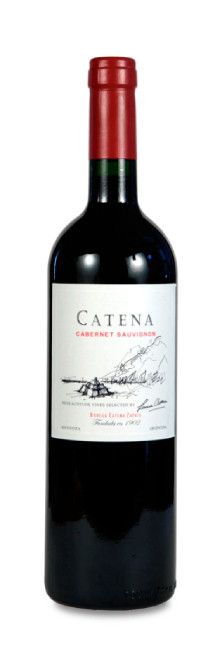
Cabernet Sauvignon is one of the most widely grown red grapes in the world. You will likely already have heard of its French or Italian version, where it grows in temperate climates; but we think you’ll be surprised with the most expressive Argentine Cabernet, which is made in a continental climate under more extreme conditions. The best way to discover it is through the Catena Zapata winery and their Catena Cabernet Sauvignon.
Cabernet Sauvignon is the house specialty. Domingo Catena, an Argentine emigrant and founder of this company in 1920, has spent his entire life producing a single-variety wine using this grape under the name of Saint Felicien. Although this red was considered the house’s best, the same couldn’t be said of the winemaking methods. The wines were made in the Italian style, with grapes from historic vineyards and aged in large barrels for several years. These wines, which had an oxidised touch, lasted until the 1970s when Nicolás Catena (grandson and third generation of the family) took over the business. After a trip to California, where he discovered new ways of winemaking, the economist returned home with an idea: to make an Argentine Cabernet Sauvignon that would be on a par with Bordeaux.
This idea was the beginning of a new era in Argentine wines, where Catena introduced a new approach that forced us to see an entire region where the focus was on the terroir. So, with each variety in the right land and soil, wines like Catena Cabernet Sauvignon are made, wines that are full of nuances, where different plots (all planted with the same grape) are blended, but where the variety grows and manifests itself in a thousand different versions. Even so, with each of their unique features, they all have in common the climate conditions they grow in, which are always marked by the high altitudes where Catena Zapata has decided to plant their vineyards, at the foot of the Andes in Mendonza. In these locations, with very cold nights and very bright and hot days, there are significant temperature contrasts that positively affect the grape ripening process. This conclusion, which has led to them finding the best vineyards, is the result of decades of research.
Catena Cabernet Sauvignon is processed and crushed, and then directly vatted in stainless steel tanks for 14 days until fermentation is complete. After this process, where this red has already been converted into wine thanks to the native yeasts, every effort is made to enhance the colour and aromas of Catena Cabernet Sauvignon. The best way to achieve this is through a maceration where the wine is in contact with the skins for 20 to 23 days. Finally, Catena Cabernet Sauvignon spends almost a year in French oak barrels (of different characteristics depending on the vintage), where it develops further and rounds off before bottling (without filtering or clarifying). Taste it and let the power of the Argentine Cabernet Sauvignon draw you in.




 Red wine
 White wine
 Rosé wine
 Primeurs
 Sherry and Port wine
 Sweet wine
 Orange wine
 Vermouth
 Champagne
 Cava
Cava Prosecco
 Lambrusco
 Crémant
 Moscato d'Asti
 Franciacorta
 Pet-Nat
 Corpinnat
 Other sparkling wines
 Rhum
Rhum Gin
Gin Whisky
 Vodka
Vodka Cognac
 Brandy
 Pastis
 Tequila
 Mezcal
 Grappa and Eau de vie
 Calvados
 Liqueurs
 Pacharán
 Apéritifs
 Wine gift boxes
 Boxed wines
 Boxed sparkling wines
 Wine bottles and glasses
 Gift card
 Non alcoholic Wine
 Non alcoholic Sparkling wine
 Non alcoholic Gin
 Other non-alcoholic drinks
 Aromas
 Wine conservation
 Decanters and aerators
 Bottle identifiers
 Corkscrews
 Service
 Glass identifiers
 Cleaners
 Accessories set
 Wine glasses
 Contact


 Mendoza


 Attention
