You can always learn or take something positive from a mistake. For Adelino Lucchese this positive thing was a wine.
The story goes that this master winemaker, who worked at the Negrar Cooperative in Villa Novare (a village in northern Italy known today as Villa Mosconi Bertani), left a barrel of recioto (a typical local sweet wine made from raisined grapes) in a corner of the cellar. By the time Lucchese realised his mistake, quite a few days had passed. It is only logical that this wine, which had been left at the mercy of the yeasts and without any control, would be dry and bitter. However, Lucchese tried it for himself, and thank goodness he did because the result was very different from what he expected. “This wine is not amaro, it's an Amarone!”.
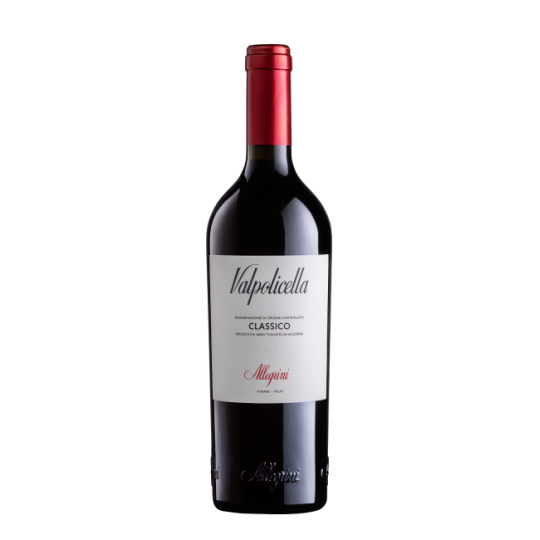
From the combination of amaro (bitter in Italian) and the ending “-uno” (a suffix that augments or improves), amarone wine was born in 1936 in the region of Valpolicella Classica (in the province of Veneto), becoming the Italian red wine par excellence that has been produced by many people. One of the leading figures among this group is the Allegrini winery, a family that has been in business since the sixteenth century and where they make Allegrini Amarone della Valpolicella Classico.
The long tradition and passing time have led Allegrini, a historical symbol of amarone, to become a company where expertise and processing techniques are perfectly balanced. In the production of Allegrini Amarone della Valpolicella Classico, the integrity of the fruit is maintained at all times. This is why the grapes are carefully selected throughout the process, using only the best and selecting the healthiest ones. These bunches, which must be in perfect shape, are dried for 3 to 4 months, reducing their weight by 40%. This step, known in Italian as appassimento, is very important, because this initial phase, where the sugar concentration is increased, is key to guaranteeing the rest of the process and ensuring that the yeasts have enough to be able to work with during fermentation. After processing all the glucose from the grapes, Allegrini Amarone della Valpolicella Classico ends up as a dry wine (1.1 g/L of sugar) that is concentrated and powerful, with high alcohol content.
All this would not be possible without Corvina, the key and crucial variety in the production of amarone. The DOCG Amarone della Valpolicella Classico also allows the addition of other grapes to this main one, like Rondinella and Oseleta (as long as the percentage of Corvina is between 45%-90%). These three grapes are native to the area and are grown in Valpolicella itself, specifically in the Classica area (the most renowned and famous of the region), where Allegrini has 100 hectares of their own vineyards, mainly in the Fumane valley. In this territory the winery has several prestigious vineyards like La Grola, Palazzo della Torre and La Poja, where the vines are trained on pergolas to prevent the grapes from rotting and protect them from the sun. However, the proximity of Lake Garda (about 20 km from the district), softens the temperatures. There isn’t much rainfall, with an annual average of 783 mm. Finally, the mineral-rich calcareous soil rounds off the character and the great quality of these wines.
The moment Lucchese realised his mistake, he had two options: to pick up and move on from that forgotten barrel; or, to get closer, check it out and learn from his mistakes. This is how Allegrini Amarone della Valpolicella Classico was born. A true symbol, an Italian red wine that should not be missed. As they say, something good comes out of every mistake. Every cloud has a silver lining.




 Red wine
 White wine
 Rosé wine
 Primeurs
 Sherry and Port wine
 Sweet wine
 Orange wine
 Vermouth
 Champagne
 Cava
Cava Prosecco
 Lambrusco
 Crémant
 Moscato d'Asti
 Franciacorta
 Pet-Nat
 Corpinnat
 Other sparkling wines
 Rhum
Rhum Gin
Gin Whisky
 Vodka
Vodka Cognac
 Brandy
 Pastis
 Tequila
 Mezcal
 Grappa and Eau de vie
 Calvados
 Liqueurs
 Pacharán
 Apéritifs
 Wine gift boxes
 Boxed wines
 Boxed sparkling wines
 Wine bottles and glasses
 Gift card
 Non alcoholic Wine
 Non alcoholic Sparkling wine
 Non alcoholic Gin
 Other non-alcoholic drinks
 Aromas
 Wine conservation
 Decanters and aerators
 Bottle identifiers
 Corkscrews
 Service
 Glass identifiers
 Cleaners
 Accessories set
 Wine glasses
 Contact


 DOC Valpolicella Classico
(Veneto)
DOC Valpolicella Classico
(Veneto)


 Attention
