


 Red wine
 White wine
 Rosé wine
 Primeurs
 Sherry and Port wine
 Sweet wine
 Orange wine
 Vermouth
 Champagne
 Cava
Cava Prosecco
 Lambrusco
 Crémant
 Moscato d'Asti
 Franciacorta
 Pet-Nat
 Corpinnat
 Other sparkling wines
 Rhum
Rhum Gin
Gin Whisky
 Vodka
Vodka Cognac
 Brandy
 Pastis
 Tequila
 Mezcal
 Grappa and Eau de vie
 Calvados
 Liqueurs
 Pacharán
 Apéritifs
 Wine gift boxes
 Boxed wines
 Boxed sparkling wines
 Wine bottles and glasses
 Gift card
 Non alcoholic Wine
 Non alcoholic Sparkling wine
 Non alcoholic Gin
 Other non-alcoholic drinks
 Aromas
 Wine conservation
 Decanters and aerators
 Bottle identifiers
 Corkscrews
 Service
 Glass identifiers
 Cleaners
 Accessories set
 Wine glasses
 Contact

Unveiling Montxo Martínez, Technical Director and Oenologist at Vivaltus
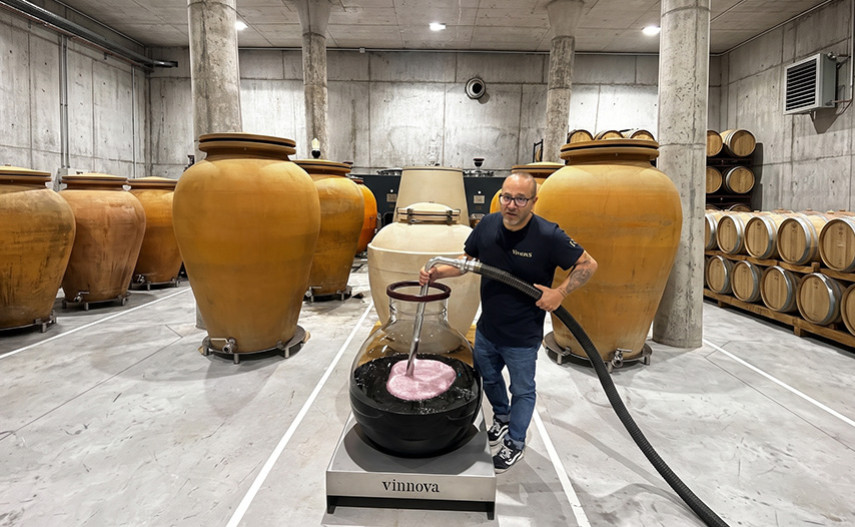
"More grapes, less drama." The T-shirt, as simple as it is striking, leaves no one indifferent. Its owner imported the idea from Argentina, a country he has visited for numerous harvests, where each vintage is celebrated with a new design. He adopted the custom because it perfectly aligned with his vision of wine, focused on naturalness, curiosity, and, as his T-shirt aptly states, without drama.
We ventured into the winery and noticed he had a bandage on one finger. It wasn't the mark of a heroic grape harvester, but rather the result of cutting himself with a knife while preparing strawberries to welcome us. A simple gesture that reveals the warmth and enthusiasm with which he greets anyone who crosses his threshold.
He then led us to what he affectionately calls, with a smile, “my Sistine Chapel.” It is his relaxation area, but also his laboratory where he seeks alternatives to wood. Quite a bold move in a denomination like Ribera del Duero, where the 300-litre oak barrel has seemingly wielded an omnipotent power for decades. He, however, does not reject wood. He simply does not want it to take centre stage.
Listening to the land through the guidance of a master
The project was initiated by the Grupo Yllera, a family saga linked to winemaking for generations, pioneering in Rueda since the 70s and present in Ribera del Duero since the 80s. In 2015, the opportunity arose to acquire an unfinished building in Curiel de Duero that had never produced wine, as it only had basic infrastructure and tanks. The intention was clear: to create a great wine, and for this, they contacted Jean-Claude Berrouet. The historic creator of Petrus accepted the proposal after careful consideration, remaining true to his philosophy of collaborating with only one winery per country.
On this journey, Berrouet became a pivotal figure for Montxo, imparting a philosophy as simple as it is demanding, focused on evoking emotion without ever losing the essence of the origin.
Upon arriving at Vivaltus, the French winemaker began by listening. To do so, he bought wines from different regions and vintages to understand the territory and discovered a crucial insight. He noticed that in some productions, wood dominated absolutely, while in others, it relinquished the spotlight. The quest lay precisely there.
“Jean-Claude is like an alchemist,” Montxo explains. And it is no exaggeration. During four intense days, they are capable of locking themselves away to work on blends, smell wines out of context, and debate until they find the right combination. A living process that they redefine a year later, demonstrating that at Vivaltus, nothing is set in stone.
Vineyard, winery, and people
The entire philosophy of Vivaltus rests on three clear pillars: the vineyard, the winery, and the people.
The vineyard is the great starting point and the true soul of Vivaltus. Instead of seeking a single homogeneous estate, the winery has crafted its identity by meticulously selecting old vineyard plots situated at altitudes between 840 and nearly 1,000 metres. It is at these elevated heights, in historic sites located in municipalities like Fuentenebro, Anguix, or the Atauta area, where the Vivaltus vineyard finds its distinctive freshness. This mosaic of soils (sands, clays, and limestones) and the diversity of microclimates allow Montxo to shape a complex and balanced blend. For him, altitude is not just a technical detail; it is the very DNA of the project, the tool that enables them to avoid excessive concentration and extract the most elegant and pure expression of their grapes.
The winery is the space where that raw material is respected and explored. Experimentation continues in the ageing room, where only 10% of the containers are alternatives to wood, such as silox, glass, or amphorae. Although it is a small percentage, it represents a clear statement of intent and explains why they even dare with aged whites, demonstrating that the local albillo has great ageing potential.
And finally, the people. The human element that connects the past with the future. “We must leave our children the vineyards in better condition than they were left to us,” Montxo summarises to explain a way of working focused on sustainability and viticultural heritage. From this same human dimension arise alliances between families, networked learning following their international stays in Mendoza, and the recognition he has received as best winemaker in Tim Atkin's awards for Rueda.
An accolade that excites him, but for which he prefers not to take all the credit. Rather than speaking of himself, he talks about his father, from whom he learned everything he knows, and the viticulturists of his village, whom he admires as much as the great international names in wine.
For him, winemaking is always a collective endeavour and in constant evolution. “We are improving, but the best wine is yet to come.” A phrase that, more than a promise, is a way of life.